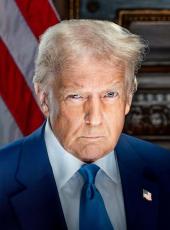
Remarks During a Meeting With President Abdelfattah Said Elsisi of Egypt and an Exchange With Reporters in Sharm El Sheikh, Egypt
President Trump. A powerful man. Very powerful. No crime. They have no crime. You put it out before it starts.
Thank you very much.
Would you want to take a couple of questions? That's—I don't care. [Inaudible]
Do you want to have a couple of questions? We're having an amazing period of time, like I think nobody's seen before. And we had a tremendous stop, as you know, in Israel. And now we're in a country where a friend of mine is a very powerful leader, and my friend is right here—the President, also the general. You know, sometimes I call him—usually I call him "the general," because he's both, and he's good at both. And they've done a fantastic job.
And they have very little crime, you know, because they don't play games. That's why. They don't play games like we do in the United States, with Governors that have no idea what they're doing. But they don't have crime.
I ask about crime, and they almost don't even know what I'm talking about. So it's a great tribute to this man. He's done a fantastic job in bringing this country together, and the United States is with him all the way.
President Elsisi. Thank you.
President Trump. Okay? All the way. And it's an honor to be with you.
President Elsisi. Thank you.
Egypt's Role in Middle East Peace Efforts
Q. Sir, what will Egypt's role play in the peace process here?
President Trump. He played a very important role, and they had a very important role with Hamas. In fact, the general was—right here—was very instrumental, because Hamas respects this country, and they respect the leadership of Egypt. So we had a—you played a very important role. I appreciate it very much. Thank you.
Iran/U.S. Sanctions/U.S. Airstrikes on Iranian Nuclear Facilities
Q. President Trump, in Israel just now, you were talking about a possible Iran peace deal. You said, "We are ready when you are."
President Trump. Right.
Q. Is that the ultimate goal with today's signing, to get——
President Trump. No, not Iran. But I think Iran will come along. They've been battered and bruised, and, you know, they're—they've got—they need some help. They have big sanctions, as you know—tremendous sanctions. I'd love to take the sanctions off when they're ready to talk.
But they can't really survive with those sanctions. Those sanctions are very tough. But at some point, they're going to say, "We want the sanctions off." We're going to end up with peace. I think Iran is going to be fine.
I know so many Iranian people. They're great people. They're smart. Great, great people. Engineers, lawyers. I mean, they're academics. But the—they took a big hit. And frankly, if we didn't hit them on the nuclear, I don't think you would have been able to have this incredible—this deal—this once-in-a-lifetime deal.
Nobody's ever seen anything like what's happening today. And countries have all come together—all different countries. Some like each other, some didn't. Most didn't. And they've all come together. Every country has come together.
And by the way, Iran did put out a statement, you know, that they support this deal very wholeheartedly. So that was in itself something.
But no, I—think they want to. That's all I do in my life: I make deals. And they want to make a deal.
[At this point, several reporters began asking questions at once.]
Hostages Held in Gaza, Palestinian Territories
Q. [Inaudible]—now that the living hostages have been returned, can you please tell us what the next steps are?
President Trump. We'll, they're going and looking for bodies. It's a pretty gruesome task. And they're—they know where numerous are, as you know. I guess five or six are in yet now. But they're looking for bodies. They know the areas and the search party is out, and they're doing it in conjunction with Israel. And they'll—they're going to be finding quite a few of them.
U.S. Cease-Fire Agreement Between Hamas and Israel/Reconstruction of Gaza, Palestinian Territories
Q. President Trump, can you tell us when phase two of the negotiations will begin?
President Trump. Well, it started. I mean, it started. As far as we're concerned, phase two has started. And you know, the phases are all a little bit mixed in with each other. You can start cleaning up. You look at Gaza, and it's—needs a lot of cleanup.
That's why, when I talked in my speech, I talked about the debris. I used the word "debris." That's debris times 10. So we're going to—they're going to really do a job. They have a lot of power. In another room, you have the wealthiest—some of the wealthiest nations in the world. All leaders—the big leaders are here: the Amirs and the Kings and everybody. And it's a very interesting group.
I guess we have like 35 countries, and that's only because there were the 35 that we invited. Everybody that we invited came. So it's—there's a lot of respect. And I think you'll see some tremendous progress, both in the Middle East—this country is doing very well. It has good leadership. It's about leadership. And it's really nice when you say, "How is your crime situation?" And they, like, don't even know what you're talking about. "What do you mean crime? We don't have crime."
Because if he has crime, he puts it out very quickly. Some people think that's not nice, but I think it's great, because people don't want to be mugged and smashed, and they don't want to be stupid people. They have a place that is doing very well. We're very proud of him, because we knew each other from the beginning.
The first time we met, it was in a hotel, and I was going to meet him, and then Hillary Clinton was following me. You remember?
[At this point, President Elsis spoke in English as follows.]
President Elsisi. Yes, yes.
President Trump. Hillary Clinton. And he liked me so much, he never even got to see Hillary. He saw her for about 2 seconds. But he didn't really want to waste a lot of time. He knew what was going to happen. But that was the first time we met, and we had a very good chemistry together, and it continues till today.
So I want to thank you all very much. I appreciate the way you covered the—this really momentous—I've never seen anything like it. The level of love, the level of respect for what it is, and it's—you know, it's peace in the Middle East, and everybody said it's not possible to do, and it's going to happen. And it is happening is—before your very eyes. And that's why it's become so fascinating.
Marco, do you have anything to say?
U.S. Secretary of State Marco A. Rubio. Egypt has been a phenomenal participant. I think both Steve and Jared will tell you the critical role they played, and they can tell you themselves. They hosted the talks here, and they're going to play a very important role now in the follow-up, the implementation of this, which is really—it's not simply about restoring Gaza. It is about transforming the region.
We have an incredible partner, a long alliance, a very capable partner here, and a tremendous collection of leaders. This is clearly, in my mind—I think in the mind of everyone in this room—probably one of the most important days for world peace in 50 years. That's not an exaggeration.
President Trump. Only 50?
Secretary Rubio. Maybe 100. [Laugher] Really since the end of World War II, Mr. President.
Q. Mr. Witkoff and Mr. Kushner, I'm curious. You played such an important role in the tactical negotiations here. What will your role be going forward as—a lot more has to be brought to the table here?
U.S. Special Envoy to the Middle East Steven C. Witkoff. The minute we had inked the deal, Jared and I were already working on the implementation side of the deal. So we're dug in. We'll be here quite a bit. That's at the direction of the President. That's probably going to be one of the most important phases here.
Jared is remarkable to work with. I talk about it all the time. And, of course, we both love working for the President, so it's a—feels like a very honorable job.
President Trump. Mr. President, would you like to say something with the interpreter?
President Elsisi. Yes. Well, first of all, let me say, I welcome you to Egypt. It's a great pleasure and an honor to have you with us here in the city of peace, Sharm El Sheikh—[inaudible]—to extend on behalf of all Egyptians and peace-lovers around the world salute the appreciation and the respect for this unprecedented and momentous accomplishment by—[inaudible].
I've been very confident that Your Excellency is the only one who's capable of bringing this about and bring an end to this war. I even said that very precisely during my communication with Your Excellency, that you are the only one who is able to bring about peace and achieve peace in this—[inaudible]. I thank you, Mr. President.
And what we need to do now is to fixate the cease-fire, make sure that it maintains—[inaudible]—that we can deliver all of the remaining—the bodies of the deceased——
President Trump. Right.
President Elsisi. ——to the families—this is very important; to bring in more humanitarian assistance into the Strip; and working very closely on following up the rest of the steps that should be taken to make this successful.
[President Elsis spoke in English as follows.]
Mr. President, you did very great job. Thank you.
President Trump. Thank you. That's very nice. Thank you.
There's a good man.
President Elsisi. Thank you.
President Trump. He's a good man. We're with him all the way.
Future Governing Structure of Gaza, Palestinian Territories
Q. Will he be on the board of peace, sir?
President Trump. I'd like to have him on the board. I'd like to. We may need an interpreter, but that's okay. [Laughter]
President Elsisi. Yes, as long as the President——
President Trump. Yes, you can't do better.
President Elsisi. ——His Excellency decides to be on the board of peace, I'll be there.
President Trump. We've had many leaders want to be on the board, actually. The board of peace. It's taken on, Steve, I'd say, a life of its own. Has it? Do you want to discuss that, what's happened?
Special Envoy Witkoff. I think we have a long list of applicants to be on that board of peace, Mr. President.
President Trump. Yes, it's—everybody wants——
That's very nice. That's better than the other way. Usually, it's the other way. Nobody wants to be on the board. But it's really taken on—this whole thing has taken on a life that's very different. So it's been really a great—honor.
And you people have done a fantastic job, I want to tell you. We appreciate it very much.
President Elsisi. Last thing——
President Trump. Thank you very much, everybody.
[Several reporters began asking questions at once.]
White House aide. Thank you, press. Let's go.
President Elsisi. Last thing——
President Trump. Wait, wait. Hold it. One second.
President Elsisi. I just want and look forward to Your Excellency's support and your sponsorship of—with us in the conference for the reconstruction.
President Trump. All right. Thank you. A hundred percent. Thank you.
Thank you, everybody. Thank you.
NOTE: The President spoke at 5:55 p.m. at the Sharm El Sheikh Congress Center. In his remarks, he referred to former Secretary of State Hillary Rodham Clinton, in her capacity as the 2016 Democratic Presidential nominee. Secretary of State Rubio and Special Envoy Witkoff referred to President Trump's son-in-law Jared C. Kushner. President Elsisi spoke in Arabic, and his remarks were translated by an interpreter. The transcript was released by the Office of Communications on October 15.
Donald J. Trump (2nd Term), Remarks During a Meeting With President Abdelfattah Said Elsisi of Egypt and an Exchange With Reporters in Sharm El Sheikh, Egypt Online by Gerhard Peters and John T. Woolley, The American Presidency Project https://www.presidency.ucsb.edu/node/379252
Filed Under
Categories
Attributes
Location