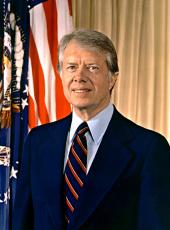
THE PRESIDENT. We've come together this morning to have the official signing of the budget for our Nation for fiscal year 1981. I will send this document to the Congress at noon today. But first I want to express my deep thanks to Jim Mcintyre, the Director of the Office of Management and Budget; to Bill Miller, Secretary of Treasury; to Charlie Schultze, my economic adviser; and to others who participated in this preparation.
This is much more than just an accounting document. Indeed, it spells out, for next year and for many years to come, the basic goals of our Nation, what we hope to achieve. It requires an extremely fine sense of sensitivity in establishing priorities, because of the intense pressures from different interest groups for a particular allocation of funds. The final budget document comprises in my own judgment as President the best balance of priorities for our entire country.
This requires a great deal of leadership in dealing with the members of the interest groups in the private sector; also in dealing with the various Federal agencies who have put forward their proposals in the strongest possible terms. I think we've come up with a very fine, balanced document, which does indeed spell out a fine life for the American people in years to come.
There are a few items that I should emphasize. This budget encompasses a strong commitment to our defense. As spelled out to the Congress late last fall, this will encompass about a 5-percent increase in budget authority, in real terms above and beyond inflation, for fiscal year 1981, compared to fiscal year 1980.
In addition, we have a strong commitment to energy. A major portion of the funds to be allocated for energy purposes will come from the windfall profits tax, now in the final stages of deliberation by the Congress. This money will go for increased production of energy in our country; for the alleviation of the fiscal burden on the shoulders of poor people by increasing energy costs; for research and development in the energy field; for increased transportation; and of course, in addition to that, for the conservation effort, which is greater than any this country or the world, indeed, has ever seen.
We are quite concerned about the quality of life of Americans in the longrange future and also want to increase the productivity of the American industrial complex. So, this budget encompasses a heavy commitment to research and development.
The last point I want to make is that we have still a very serious blight on the American social and economic scene in high unemployment among young people. This budget in subsequent years will encompass major initiatives in increasing the job opportunities for young people, and the training that might prepare them for permanent jobs, primarily in the private sector.
There's one overwhelming characteristic of this budget: above and beyond all other domestic issues, the control of inflation is the most important. This is a fairly stringent budget. There is no waste in it that we could possibly eliminate. It has, as one of its prime characteristics, a marked reduction in the Federal deficit. We have cut the Federal deficit since 1976 by $50 billion, and this is a budget which has the lowest deficit in 7 years. As a matter of fact, in 1976 the percentage of our GNP covered by the Federal deficit was 4.6 percent. This budget encompasses a deficit of six-tenths of 1 percent, a major reduction. As a matter of fact, if we are pleasantly surprised—I'm not predicting this—and if the economy does stay strong enough that the unemployment level would remain as it is now, a little bit less than 6 percent, we would have a surplus in the budget for 1981. I'm not predicting that, but it shows what a stringent budget it is.
This is not an easy thing to accomplish. We have to fight off sometimes very powerful special interest groups who are constantly trying to derive some benefit for themselves at the expense of the general public. Even in the case of removing unwarranted Federal regulation from the private sector, there is an inclination to have protections for these special elements of our society at the expense of the consumers and at the expense of competition on which our free enterprise system is based. We are going to continue to fight off these special interest groups and keep the budget deficit down, and keep a well-balanced presentation to the Congress for the future of our Nation.
I'm very pleased with this budget. It's the result of an awful lot of work. And I particularly want to express my thanks to all of the staff members standing behind me, representing primarily the Office of Management and Budget and the Department of the Treasury. And Jim, it's with a great deal of pleasure now that I sign this budget; one copy to go to the Vice President, who is the President of the U.S. Senate, which I'll sign first.
A copy to go to the Speaker of the House of Representatives.
And a copy for the official files of the Office of Management and Budget.
Now all you've got to do is get it passed through Congress without change. [Laughter] Jim, congratulations. Do you want to say just a word?
MR. MCINTYRE. Mr. President, I would agree with you that this is an appropriate budget to meet our national concerns. And I'd like to thank you for your support in this process, because you've had to say no a lot of times also. I appreciate that very much. I'd also like to thank the staff at OMB for their dedication and their professionalism and hard work in putting this budget together. They've done a superb job.
THE PRESIDENT. It's been a good team effort.
MR. McINTYRE. Yes, sir, it has.
THE PRESIDENT. Well, again, I want to express my thanks to all of you. Now it's time to start working on 1982. [Laughter]
Note: The President spoke at 9:31 a.m. in the Cabinet Room at the White House.
Jimmy Carter, Budget Message Remarks at the Signing Ceremony. Online by Gerhard Peters and John T. Woolley, The American Presidency Project https://www.presidency.ucsb.edu/node/249612